Showing posts with label Raag Zeelaf. Show all posts

Monday, May 5, 2025

1990 Vienna Concert — Munshi Raziuddin and Sons

When Reality Dampens Ambition

In the post on the 1988 concert, I had mentioned that Razi Mian, Fareed and I had been thinking of organizing their first performances beyond the Subcontinent. This was a flight of fantasy and faith on all our parts. None of us had a clue as to what it would take to organize a European concert tour. Importantly, figuring out a way to recuperate the airfares of seven people, housing them, and organizing their transport across the Continent seemed formidable. To say nothing of organizing a programme of concerts.


Whenever I voiced my worries and felt daunted by the prospect ahead of us, Munshi Raziuddin would retort in his inimitable manner “Sahibzade mian, koi parayshanee ki baat nahin, Allah raastay kholay ga…” (Dear Boy, there is nothing to worry about, Allah will remove the obstacles…).


And so, a proverbial bare bones budget was put together for flights to London, a train trip to Vienna, and performance engagements in London, Vienna and Amsterdam. While they used their incipient fan club and contacts to schedule engagements in London and Amsterdam, the organization of the Vienna leg of the tour, which would last a week, fell on me.


Of the numerous concerns on my mind was that Nusrat Fateh Ali had opened a one-week music festival in Vienna the previous year. Nusrat took Vienna by storm (as he did almost all other European capitals) and the overflowing local audiences had been captivated by the dynamism and energy of his musical style, which was quite different from the more mellow mood of Munshi Raziuddin and his sons. As a result of his Vienna performance, Nusrat’s recordings were a regular feature of the evening international music hour of FM4, the local English language radio station. My worry was that Vienna’s audiences would not take to the other, more tempered style of Qawwali.


Then there were any number of other, more practical, worries. While he did not mention it, I was aware that Munshi Raziuddin had committed quite a bit of his savings into the travel required from Pakistan, and we just could not afford to fail. My being a UN functionary hardly afforded familiarity with the world of logistics, business, and musical promotion. Believe me, I spent a few sleepless nights pondering over these sorts of things, leave alone having nightmares of an empty hall somewhere in Vienna with no one by way of an audience!


… Divine and Human Intervention Saves the Day


But Razi Mian’s faith turned out to be well-founded, and Allah did, after all, open raastas. A couple of weeks ahead of their arrival, I went down to the Pakistan Embassy to give them an idea on what was being planned. The Embassy was awaiting the arrival of a new ambassador and a young First Secretary was ChargΓ© d’Affairs for the interim. He sent me to his number two, a young diplomat by the name of Amjad Sial, a most resourceful and pleasant young man. Well, Amjad decided to take things seriously and got the wheels of his network in motion. Before we knew it a rather successful Sikh restaurant owner named Toni, who had a Pakistani partner, joined our effort. Toni undertook to organize the public concert, after hearing a tape of one of their recordings. We found a Sri Lankan chap to rent us his VW microbus and drive it for transport over the week. A dear friend, Gerda Hassan Khan, had a vacant city apartment where we could put them up. This same friend had a large enough suburban house where we could hold a private mehfil.


All this fell into place in a couple of daysall my trepidations vanished. We decided to do three concerts over the seven day-perioda concert for the diplomatic community at the Pakistan Ambassador’s residence, a private concert at the aforementioned friend’s house, and a public concert at a fairly decent hall which we managed to rent. They would arrive by train from London and depart immediately by road after the public concert for Amsterdam, where they had to perform at a music festival the day after. Once everything fell in place, it all seemed ridiculously simple and straightforward. May Allah bless Gerda, Amjad Sial, Tony and the others. 


… The Ambitions are Realized

And so they arrived in Vienna on a raw, grey, cold and miserable November Sunday evening. Seeing Razi Mian alight from the train with his infectious smile and the familiar twinkle of his eye radiated a ray of sunshine illuminating the grey evening. “Kyun mian Syed! Hum pohonch gayΓ©!” he exclaimed (Well master Syed! We have arrived!). We embraced, the euphoria causing peels of spontaneous laughter. We repaired to my place, where my Indian wife had prepared her signature and unbeatable biryani for dinner. On the way Razi Mian told me that this was his second trip to Europe, the first one was to Paris in the 1930’s when he accompanied a Sufi teacher. In his usual style he took it all in with a running commentary (most of it really witty and irreverent) of what transpired on the train journey and in their transit in London. The sons were a bit awed by the clean, orderly and pretty vistas, quite a contrast to the unceasing energy, chaos and colour of Karachi and Qawwal Gali. It was a joy to see their awe at the order of things. The uniqueness of the first discovery is something that cannot be repeated. 


On his arrival at our doorstep, my wife stooped down to touch Razi Mian’s feet in deference. Razi Mian seemed to be overcome with embarrassment at being so greeted, as he touched her head by way of blessing her.


As soon as he found his bearings (which did not take long), Munshi Raziuddn asked to hear recordings of Micheal Jackson, the current rock rage. “Mian sahib, yeh Michael Jackson kyaa cheez hai?” (Young man, what kind of thing is this Michael Jackson?). I think we listened to “Thriller”, and Munshi Ji seemed sufficiently impressed to try and discern the raagas that formed the melodic base of various tracks. This hopeless endeavour achieved little except to make everyone collapse in laughter.


We eventually went into dinner and the apartment resonated with noisy conversation, laughter and a general warm chaos. My sons, seven and five years old, were hugged, cuddled and spoiled to their hearts’ content. All this propelled me suddenly into a familiar atmosphere of the warmth and affection that permeated my Karachi of that time. 


The muscles of the body relaxed while the inner glow and smile grew … 


I had taken the week off, as much to oversee events as to spend as much time as possible with Razi Mian and his sons. Fareed seemed impressed with my taking this time off, observing “Yaar dekho! Aam taur pur logh vilayat main apnay baap kay liay haftay bhur ki chutti nahin laitay hain…” (Just look at that! Usually people in the west do not take a week off from work even for their own fathers…) The next day was absorbed by sightseeing, the splendid views of the city from the surrounding hills (which were compared to Murree) as well as a drive through the centre of town (where everyone was terribly impressed that cars and people actually stopped at red traffic lights, unlike Karachi…). The imperiousness of the inner-city buildings evoked comparisons with the imagery of the stories of Alif Laila (the Thousand and One Nights). 


An Eventful Dinner

The next night, we had organized a dinner with some friends, who were more than curious to meet this group, since they had heard so much from us about the music and traditions. Initially, the conversation was muted with our two sets of guests trying to size up each other. There was a particular couple, Christof and Elisabeth Penzias, who were the ice breakers. Christof came straight from work, in his business suit and tie, brimming with confidence and ready to make short shrift of the oriental spiritualism we had talked aboutand which did not impress him. His wife, Elisabeth, was altogether different and of a dreamy poetic and artistic mind. At some point Elise asked Fareed why Qawwali invoked the name of Ali. Fareed deferred to the father and therein started the evening. 


Munshi Raziuddin sat on the floor, and the rest of us arranged ourselves around him as best as we could. He spoke his lyrical Urdu, and I had to interpret for our company. After he went into an explanation of Hazrat Ali’s significance to Sufi Qawwali, Christof rather provocatively said that he found all of this rather interesting but of no consequence, as he did not believe in God, and had left the Church at an early age. 


Munshi Raziuddin turned his attention for a bit, looking deep into Christof’s eyes.


“Mian in say kehyay kay yeh nihayat hi Ulloo Kay Patthay hain!”

(Please tell him that he is the son of an owl!)


“Sooraj tullu hotha hay, aur ghuroob hota hay…”

(The sun rises and sets)


“Aaap agar undhay hon aur suraj na dekh sakain”

(If you are blind and cannot see the sun)


“Iss kay yeh nahin manay kay sooraj nahin hai!”

(Your unawareness does not mean that the sun does not exist!)


Now I had a problemhow was I to translate the sense behind the first phrase? In subcontinental parlance “Uloo ka Pattha” (Son of an owl) is a derogatory term, signifying (to put it mildly) the height of idiocy. In Occidental culture the owl is, on the contrary, the symbol of wisdom. However, I managed to get both literal and figurative meanings across to Christof. 


With that as his opening salvo, Munshi Raziuddin summarized Avicenna’s logical argument for the existence of God (“Proof of the Truthful”), linked it to the legend of Khusro’s response to Pandit Gopal and Khusro’s subsequent first expression of Qaul/Qalbana in Khat/Zeelaf, reciting the first verse of that piece. In the space of a few minutes, Munshiji spanned logic, spirituality and Qawwali. This left his audience rather speechless.


Off came the tie and jacket and down came Christof from his perch on a sofa to sit at Munshi Raziuddin’s knee…


The discussion then wandered into all sorts of directions, musical, philosophical and spiritual, commanding my entire mental resources for translating the outpouring of ideas. 


The discussion went on till the wee hours of the next morning, despite it being a weekday. At the end of it, while making some profound point, Munshi Raziuddin entered a state of vajd (trance), loudly chanting “Haq!” (Truth!) and fell into a sajda (prostration). The suddenness of this movement caused our guests to think that he had a seizure or worse yet, a heart attack. We explained his state to our ashen faced friends, and he soon regained his composure, to their relief. 


“Aaj asli Qawwali hui hay!” He said (today we have had a real qawwali (remembrance)).


Needless to say, that evening created an instant fan club. I last met Christof a couple of months ago. More than thirty years after the event he recalled that evening in vivid detail, confessing to having been taught a lesson in humility by what he thought was “just an oriental singer” but turned out to be a man of deep spirituality, wisdom, humour and knowledge. 


The Performances

I discovered another facet of Munshiji’s personality that weekthat of a strict and concentrated Ustaad combined with a gentle, caring fathertwo seemingly opposed characters. He would ask Fareed or Abu Mohammad to sing one or the other phrase running through his mind and stop them with a rather abrupt scolding grunt at times, asking them to use one or the other subtle inflection. I was so impressed by his ability to reconstruct what had just been sung, and his relentless pursuit to shape the performance he envisaged. 


And yet, one of the first things he asked me was to get a supply of almonds and other dry fruit, which he ground into a milk-based tonic, which he gave the sons three times a day to fortify their energies against the cold. The tenderness of his eye reminded me of my grandmother, who prepared the same sort of tonic for us children every winter….


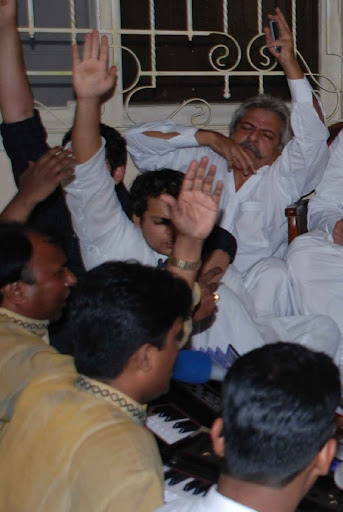
The three performances we held that week were all very different. The one at the ambassadorial residence was stiff and formalistic as all diplomatic events are. The second performance, at Gerda’s home, involved friends and music enthusiasts, becoming a full scale Mehfil in the heart of Central Europe. This Mehfil is presented here. The third performance, the public one, turned out to be a spirited and vibrant affair and it was held on the eve of their departure for Amsterdam.


The public performance was held at a time when there was no YouTube, Internet etc., so the subcontinental population of Venna was starved of music and already charged with a healthy nostalgia. In addition, Nusrat’s Fateh Ali’s performance and impact over the previous year had whetted local interest in Qawwali. 


Fareed showed a keen sense of his audience and, in no time, had them dancing away in the aisles and in front of the stage…The concert ran for couple of hours till 10:30 pm, but neither singers nor performers wanted to let up. At about 10:45 I grew alarmed. According to local law the music could not go on past 10:30. In addition they had to leave soon for Amsterdam to make it for the next morning’s engagement. Munshiji and I were in the wings of the stage and I signaled Ayaz, imploring him to finish. He announced the end of the performance on account of their having to take a long road journey. His announcement was met with audience protest and yelled requests for just one more encore. At which point Ayaz got all of the group to pick up their instruments, walk down the front of the stage and they trooped out through the main aisle, audience on either side, to the exit of the hall, with Ayaz singing away all along! They walked into the waiting microbus, with the Sri Lankan driver. We thus bundled our intrepid Qawwals, the driver, a supply of shami kababs and parathas and bid them a safe journey to Amsterdam. It snowed on the way but the overnight drive got them to Amsterdam to the stage just in time for the next performance. 


After all this, I retired to my bed, exhausted after the intense week, to sleep over the whole weekend and acclimatize myself to a normal pace of life, less filled with adrenaline and emotion.


The Mehfil


Against the memory of the intensity, the euphoria, and the laughter of that week, talking about this mehfil seems a bit anticlimactic.


I love the spoken introduction (Track 2) by Razi Mian. It goes over a familiar story, but Munshiji’s beautiful language, its rhythm and elegance never cease to move me. The opening piece (Geet Govind/Khat Zeelaf) has a classic flavor that is rarely performed nowadays. It formed a soft entry into the performance.


They come into full stride by track 6 (Chaap Tilak) despite the classical authenticity they had calibrated the performance to get both the initiated and the uninitiated swaying in appreciation… I love the bandishes and the girah bandi employed in this performance. As a friend observed, the audience began to be transported into a musical experience that transcended language and cultural restraints. 


Then there is this lovely, melancholicPiya Ke Milan Ki Aas in Raaga Jogya, a very difficult transition to a beautiful classical thumree. I assume this was requested by one of the audience. 


The rest of the performance weaves in and out of the kalaam of Baba Bulleh Shah, Khawaja Ghulam Fareed and Waris Shah as well as that of Hazrat Ameer Khusro.


The switch to Punjabi Sufi poetry was, in no small measure, due to their recognition of Hayat Mehdi, my dear friend, mentor and elder brother, who they met after a decade or so. Hayat had a distinguished career as Pakistan’s ambassador to Austria and senior official of the United Nations. Despite his decades abroad with his international career, Hayat’s heart and soul has never left Lahore and this mehfil offered him an emotional catharsis. 


The Punjabi poetry is spliced with couplets in Urdu, Persian and even, at two points, Sindhi and Pushto, in a beautiful tapestry of poetry and linguistic colour.


To my mind the best of the Punjabi kalaams (tracks 10-12) was the recitation of “Jogya” from Waris Shah’s “Heer Ranja”. Fareed was very brave in reciting this as it is inextricably associated with the genius of Nusrat Fateh Ali Khan. This recitation was at Hayat’s request. I doubt that they would have sung it for anyone else, not wanting to tread on Nusrat’s path. But they give it their flavor in the girah baandi, not least by coupling it with a second piece “Main ni jana khhairan day naal”, a beautiful transition…


Overall the tempered performance conceals a controlled energy. Nowadays Qawwals tend to vent their energies by bellowing or screaming, usually an unpleasant experience. In this instance, the disciplinary effect of Razi Mian’s presence channeled the energy to creativity in poetic span and musicality. 


I realized the energy in the performance, though. After the customary “dhamaal” at the conclusion of the last piece “Laal Mairee”, Fareed lifted and showed me Ali Akbar’s tabla.


The skin of the tabla had blood on it, and Ali Akbar’s fingers were bruised and raw….


End Note

Thus began their international career. Today, 35 years later, there is no continent Fareed and Abu Mohammad and their ensemble have not visited. New York and Delhi seemed like their backyard and the prayers, training and care of Munshi Raziuddin have rewarded them the due fruits of their labour. They have been to Vienna several times since. Their second trip was two years later when they inaugurated a music festival organized by an Indophile friend. That trip was tastefully organized under an outdoor shamiana (tent), and TV and impresarios in attendance. 


This first trip and our shared times became the subject for granular discussion for years thereafter, inspiring loving memories, laughter and creating bonds that time cannot erase.Asif Mamu.


Playlist

  1. Sazeena
  2. Intro — (Beautiful lyrical language, classical vocabulary) [09:35]
  3. Sawal—Geet Govind [11:00]
  4. Jawab—Khat/Zeelaf [17:46 ]
  5. Manqabat: Mun Kuto Maula [20:00]
  6. Naat: Marhaba Ya Nur al Ainee [37:54]
  7. Khwaja Ji/Tu Bara Ghareeb Nawaz [52:30]
  8. Chaap Tilak [1:20:30]
  9. Pya kay Milnay ki Aas/Raaga Jogiya [2:04:40]
  10. Hut vey Mullah/Namee danam/Tairay Ishq Nachaya [2:17:30]
  11. Mai Nahin Jana Jogi de Naal [2:43:40]
  12. Main Nahin Jana Khairayan de Naal [3:01:50]
  13. Laal Mairee [3:06:50]
  14. Salam [3:17:10]


Saturday, May 5, 2012

1992 Mehfil - Munshi Raziuddin & Sons

We spent that year’s summer leave in Islamabad with my cousin Minni and Nusrat Ali Shah, her husband, a politician of some consequence in the Islamabad of that era.

Abu Mohammad (Munshi Raziuddin’s second son and one of the three principle singers in the troupe) had been told of our trip, and he called Islamabad. I told him that it would be a pity that we would not be coming to Karachi and, consequently, in keeping with tradition, we would not meet nor have a musical evening that year. Munshi Raziuddin sent word that they would not countenance such mutual deprivation, and they volunteered to come to Islamabad. And so they did, braving an exhausting overnight train journey from Karachi.


In yesteryear, the train journeys in Pakistan were an adventure. Trains like Tezgam (fleet footed), Khyber Mail, Chenab Express, Tezrao (speedy flow), and Bolan Mail connected the far flung corners of the country. The British-built train stations, whether large or small, boasted a characteristic colonial architecture that was functionally suited to the environment of the country, a holdover from the majesty of the Raj and a tribute to the common sense and aesthetics of the designing civil engineers. The sounds and smells of train stations are something that live with me to this day, and not least were the smells and taste of the food. The biryanee, whether served by the Pakistan Western Railway or the hawkers and vendors at train stations, remains one of the culinary legends of the subcontinent. However the years have not been kind—the railways have fallen apart and train journeys have become an excruciating experience for those unfortunate or mad enough to undertake this form of travel. Such were the travails that Munshi Raziuddin and the group undertook in their journey of love to be with us that day.

They arrived In Islamabad in the afternoon and arrangements were made for them to rest. Munshi Raziuddin, irrepressible as he was, instead spent a couple of hours in mirthful conversation describing the rigours of the train journey and catching up on matters personal, worldly and spiritual. The conversation and laughter would have gone on until the evening when the mehfil (concert) was to start, had I not implored him to sleep and get some rest.

The energy generated by the joyous afternoon reunion is testified by the test recording (Track 1). What was supposed to be a two-minute test piece went on for about 16 minutes. Starting with Chayya Nut, they wove together snippets of all my favourite raagas and cheez (musical items). These comprise a comprehensive performance in itself, and an exhilarating one. As far as I was concerned, the evening could have stopped there and I could have gone to bed, musically satiated.

That evening, Minni and Nusrat invited several Islamabad notables. The Islamabad crowd was a far cry from the rambunctious gatherings in Karachi. Here the people were affected, terribly conscious of their place in the political, bureaucratic and social pecking order—a very muted, stiff and self-conscious group. No wonder that Pakistan is in the terrible state that it is, with its destiny in the hands of this constipated lot! An indefatigable lady, a political type, who till this day is very much a fixture of the inner circles in Islamabad, provided a remarkable counterpoint. She rocked and rolled away with abandon, quite oblivious of the effect her ample endowments created on the stuffy gathering.

As is usual, the Manqabat is the point of departure for the mehfil and a short mystical/musical/contextual oral introduction is presented.  In the introduction that evening, Munshi Raziuddin did something unusual in going to a philosophical rather than musical plane. He recalled a reported instructional discussion between the Prophet of Islam and his regent and son-in-law, Hazrat Ali. In response to the Prophet’s question, Hazrat Ali states that the Qur’an would divinely guide decisions in his tenure of governance. The Prophet questions Ali as to what he would do if clear guidance were not found in the Qur’an. Ali states that he would follow the ahadis and traditions. Again, came the question, what if these did not provide clear instruction, to which Ali replies that he would exercise his own judgment and reason in the light of the divine guidance of the Qur’an and the precedents recorded in the ahadis.

I think this was Munshi Raziuddin’s answer to a question that I had posed him once, some years earlier, where we had debated the question of reason versus belief. In this recollection he implies that divine guidance, belief and reason have their respective and clear roles in worldly life. Divine guidance and belief establish boundaries within which reason is exercised in the conduct of public, social and private matters. Divine guidance and reason are two pillars supporting human conduct. One without the other is meaningless. Hazrat Ali’s life and example is the epitome of the power of combining the two in the quest for social justice and common human decency. I suppose Munshi Raziuddin also saw it fit to recall this perspective for the benefit of some of those who were Powers That Be in Islamabad…

All this points to the centrality of Ali’s worldview to the Sufi ethos. As a sufi, in a state of wajd (ecstasy) proclaimed:

Banay sufi jazbaat main behnay waaley! 
Qalandar bane ishq main jalnay walay! 
Qutub bane ranj o gham sehnay walay! 
Wali ban gaye Yaa Ali kehnay wale!!! 
YAA ALI ! HAQ!!!!

The concert proceeds with a series of manqabats and qaseedas, culminating with Baro Ghi Ke Diye Na, Aaj Bhadawa and Mere Bane ki Baat na Puchcho. These established the strongly devotional and mystical character of the mehfil.

Musically, in my opinion, the high point of the first part is the recital of Raaga Bahar Phool Rahi Sarson. Abu Mohammad’s galakari is quite brilliant in this one. Whereas this piece is normally rendered in Purbi couplets, they wove in Persian couplets one of which Munshi Raziuddin directed at me (3:20):

“Sahibzadeh Sahib…Na mohtajam ba gul gashtay chaman ay baaghban hargiz, Bahaar I sadhh chaman dar abid i jaana na mi gham (?)…”

Now, don’t ask me what this signifies, my ignorance prevents me from comprehending the true meaning and beauty of the poetry, but the sound of Persian is just so melodic! Could someone with the better education enlighten me with the meaning of this and its preceding couplets?

There is a lively rendition of a familiar Qawwali Khawaja Piya. This is a popular dhammal piece, but listen to the digression from about 07:05 to 07:54 where there is a switch of tempo and flirtation with khyaal style exposition. Transitions such as these are difficult and not for the faint of heart! What mastery and control over the musical expression! And then shortly afterwards they float off to Khausro’s world of ecstatic worship, to the world of dervishes, with Nami Danam chi Manzil Bood!

Nami danam chi manzil bood shab jaay ki man boodam;
Baharsu raqs-e bismil bood shab jaay ki man boodam.
Pari paikar nigaar-e sarw qadde laala rukhsare;
Sarapa aafat-e dil bood shab jaay ki man boodam.
Khuda khud meer-e majlis bood andar laamakan Khusrau;
Muhammad shamm-e mehfil bood shab jaay ki man boodam.


English Translation:

I wonder what was the place where I was last night,
All around me were half-slaughtered victims of love, tossing about in agony.
There was a nymph-like beloved with cypress-like form and tulip-like face,
Ruthlessly playing havoc with the hearts of the lovers.
God himself was the master of ceremonies in that heavenly court,
Oh Khusrau, where (the face of) the Prophet too was shedding light like a candle. [1]


The mid piece of the concert is a rendition of Sundhar in Tilak Kamod, a raaga that is eternal. By this time they were well settled in and there is a distinct calmness in the air. Listen to the tremulous voice of Munshi Raziuddin with evocative and unusual Hindi/Khari Boli bandishes. Munshi Raziuddin comes into his own, at several points, a tender and mellifluous voice, tremulous with age but strong in musicality and precise in enunciation. Every time I pay homage at his grave, I hear this voice as my parting impression and our farewell.

In deference to the Punjabi audience they sang the piece Ni Mein Jana Kheriyaan De Naal (O! I will not go with the Khers) by Waris Shah, the 18th century poet of the Great Punjabi Love Story Heer-Ranjha. Heer is married off by her family to someone from the village of Kher, and Ranjah, broken hearted, becomes a jogi. They are reunited when he wanders through Kher, and she escapes with Ranjah, the jogi, to return with him to her parents’ village. A few years previously when the group came to Vienna, I had asked them to include the piece Mein Nai Jana Jogi De Naal in their repertoire. There is a masterful rendition of this by Nusrat Fateh Ali which is a favourite. Rather than replicate Nusrat’s Dhamaal, they slowed the tempo, and blended it into their Gayaki style, and then Ayyaz, during the performance, sang a second movement, his innovation, with the phrase Veh Mein Nai Jana Khareyaan De Naal. How this came about is the subject of another anecdote that awaits a future post on this blog.

In the next track Nami danam chi manzil bood they blend Khusrau's Persian with a couple of Munshi Raziuddin's favourite Urdu couplets Voh kaun sa tha maqam e junoon khuda jane and kya kahoon, kisse kahoon, kaise khaoon, kyoonkar kahoon as well as with Hafiz's Mun malak boodam o ferdos e baraeen jayam bood, Adam avurd dareen deyr e kharaba badam (I was an angel and my dwelling was sublime Paradise, But Adam brought me into this seemingly flourished but ruined cloister).  Wah!  

And then this standard, yet ever so neat, poetic transition into Yaad Hai Kuchch bhi Hamari Kanhaiya, a Hindi Bhajjan, via Momin Khan Momin's Voh jo ham mein tum mein qaraar thaa tumhein yaad ho ke na yaad ho, Vahi yaani vaadaa nibaah ka tumhein yaad ho ke na yaad ho (That peace which existed between you and I, whether you remember it or not, That promise of loyalty, whether you remember it or not).  What an apt transition from one kalam into another completely dissimilar one; leading the listener from a contemplation of some outwordly manzil (station) of junoon (excitement) to the theme of yaad (remembrance)!

In developing Kanhaiyya, they construct an ornament of verses drawn from different poets that explore the emotions of yaad, intezaar (longing), and judai/furaq (separation). The first verse is Iqbal's couplet Bagh-e-bahisht se mujhe hukm-e-safar diya tha kyon, Kaar-e-jahan daraaz hai, ab mera intezar kar (Why did You order me to journey out of Paradise, The affairs of this world occupy me, You must now wait for me); an unknown Purbi poet's Sona lenay Pi gaye aur kabse gaye pardes, Sona mila na Pi mila, moray chandi ho gaye kes (My beloved left in search of gold, Neither he nor the gold was found, [in forlorn waiting] my hair turned white); Khusrau's Purbi verse Jo mein jaanti bichrat hain saiyan, ghongta mein aag laga dayti ... (Had I known my beloved was departing, I would have burned my veil); and another one of Munshi Razi's oft-recited verses Mora haat deikh baraham yeh bata key yaar milayga kab, Tere mon se nikle khuda kare keh abhi abhi is hi haal mein (O Brahman read my hand and tell me when I will meet my beloved, May you utter with God's will that [I will meet him] now and in this very state of being).

In all of Sufi mystical poetry, there are several levels of meaning. Taken literally, the poetry can be interpreted as the yearning for a temporal beloved. Beautiful as the love poetry is, its full power lies in the discovery of deeper meaning. At one level the poetry expresses the love that the Sufi poet (for example Khusrau) has for his spiritual guide (Hazrat Nizamuddin Auliya) as the connection to God. In the ultimate, it expresses the direct desire for communion between the Sufi and the Creator, the desire for the Sufi to be united with the Creator, the ultimate beloved. Hence temporal life is expressed as separation from the Eternal and passage from the temporal world to the Eternal a joyous reunion with the Creator, for which the Sufi thirsts whilst in the temporal world.

The taraana in Raaga Zeelaf is yet again embellished with embedded verses:  Bahaan churahe jahat ho so nibal jan kar mohe, Phir dame say jao ge tab marad badoon gi tohe and Hazrat Usman Harooni's Biya jana tamasha kun key dar ambohey ja bazan, Basad saman e ruswaee sarey bazar mi raqsam. (Come Beloved! See the spectacle that in the crowd of the intrepid and daring, With a hundred ignominies in the heart of the market, I dance!)

The fluency of these poetic and musical transitions display a mastery that never ceases to amaze me.  Together in these three tracks, in the space of just a few minutes, they manage a tour d’horizon of all the major linguistic and poetic forms of North West India!

Their Tarana in Raga Zeelaf on this occasion was a very special expression of a center piece in their repertoire. This Taraana is only surpassed by what Ayyaz sang, but I did not record, on another occasion. Their second trip to Vienna was organized with a friend and Indophile, Andy Malleta. Andy owns a large apartment building in town, with an ample central courtyard, in which he organized an oriental musical festival. He erected a shamiana in the courtyard with a farshi (floor) seating arrangement, diyas and the works--a beautiful setting. Abu Mohammad and Ayyaz opened the festival, to be followed the next day by some Korean shamans who sang, and so on. Anyways, before the actual performance, Ayyaz and I sat in a room, by ourselves, and Ayyaz by way of Ryaaz, began to recite a succession of taranas with the Tanpura as his only accompaniment. The intimacy of the moment and his intensity were such that I do not know which of us was the more transported. He sang for about half an hour and one walked out of that interlude with the head in the clouds. They sang beautifully that night and were featured on Austrian television.

They conclude with a Qaseeda devoted to the Prophet’s grandson, Hazrat Imam Hussain, the younger son of Hazrat Ali, and Bibi Fatima, the only surviving child of the Prophet. I have a better performance of this piece, where they went from Qawwali to the Marsiyah form--that too will have to await another post on this blog. However this short expose may introduce the reader to the Imam Hussain epic which is the Islamic passion play of supreme sacrifice while speaking Truth to Brute Power.

All in all, the Islamabad evening was one in which the audience did not inspire the musicians, but the musical force of the Qawwals was such that they were able to pull the audience to a higher and more refined level of poetic and musical appreciation. This was something that Munshi Raziuddin held as sacrosanct in his effort, to pull his audience to his plane rather than descend to the common temperament. On my enquiring as to how he managed this, he told me that he would constantly survey his audience, seeking resonances in individuals and would “enlist” the support of one or two who seemed to appreciate the music, then turn his attention to another and then another, fine tuning the music and poetry to create a string of enthusiasts in his audience. This is not just a matter of technique, it lies at the heart of the Sufi experience, the contact with an individual, then another, yet another until there is an inexplicable transmission of shared sentiment to a whole community, the audience at a mehfil, or a following of a sage.

This has been learned by his sons to great effect. I have heard them sing classical khyaal mehfils while also hearing them create the atmosphere of a Mehfil-i-Samaa and they even have totally secularized the Qawwali form to recite Sufiana kalam at a mandir!

This, I would suggest, is the essence of Qawwali. It inspires the spirituality existent in every faith, and creates a sense of connection with the eternal. I have asserted elsewhere that the Islamic influence in the subcontinent was not so much the doing of conquerors and kings. It certainly was not inspired by the merciless harangue of the mullah. Indo-Islamic civilization grew and thrived primarily as a result of the message of love, universal brotherhood, justice, humanity and peace conveyed by the various Auliyas and Sufi saints. Qawwali was one means of conveying this message. Humbleness, personal example and compassion were another. One can testify with heartwarming conviction that, despite the madness of this present time, at least one of those traditions is alive and thriving. May the Almighty always will it that way.—Asif Mamu

Notes:
1. The poem and the translation both are taken from the site http://www.alif-india.com/love.html and is added here with the permission of the site owner. Mr Yousuf Saeed holds the copyright of this poem

Vol I
1. Riyaaz (Raagas Chaya Nat, Bilawal, Suha, Malkauns, Nand)
2. Qaul - Man Kunto Maula
3. Baro Ghee Ke Diyena Bhaile Aamana Ke Lallana - Aaj Badhawa

Vol II
1. Haryala Bana Ladala - Mere Bane Ki Baat Na Puchcho
2. Phool Rahin Sarsoon (Raaga Bahar)
3. Piya Piya - Tarana (Raaga Suha)
4. Khwaja Piya Piya - Nami Danam Ke Akhir Chun Dam-e-Deedar Mi Raqsam

Vol III
1. Chaap Tilak
2. Baji Lagi Tan Man Dhan - Chaap Tilak - Dam Hamadam Ali Ali
3. Mun Bajras Har Dum Ali Ali
4. Ali Ghar Deyo Badhai
5. Paniya Bharan Nahi De - Mangal Karan Sundhar (Raaga Tilak Kamod)

Vol IV
1. Ni Mein Jana Kheriyaan De Naal
2. Nami Danam Che Manzil Bood - Kanaiyyah - Tarana Zeelaf - Aye Dilbagir Daman-e-Sultan-e-Auliya

Friday, July 25, 2008

1988 Mehfil - Munshi Raziuddin & Sons

This session commemorated the first anniversary of my mother's passage, and was held at our house in Defence Society, Karachi. We thought it befitting of her memory to hold a qawwali mehfil to listen to some of her favourite music. From the outset, the atmosphere was charged. The underlying theme was one of remembrance. The emotional undertones made Razi Mian and his sons surpass themselves and almost every piece in this session is a gem.


The Qaul - Mun Kunto Maula set the stage, with its ethereal alaap. I feel that this is their best rendition of this Qaul. And while the 1969 Manzoor Niazi aur Hamnawa version (link) is unsurpassed, the version sung at this session is technically brilliant.

1988 Troupe
1988 Session - Munshi Razi & Troupe - Masters of the Art

They next went into a grand rendition of a combination of Raaga Adana and Bahaar, the Adana was set to the apt bandish Tairay Darbar Main Ayin Hun. This rendition was sung with Ayaz at his best. In this piece and in subsequent pieces, his galakari is both complex and sweet. This is the very gaayaki angh of vocal traditions that is championed by Vilayat Khan and his Gharana on the sitar. Ironically, Ayaz consciously modulates and emulates the melodic structure of the sitar rendition of the raaga, and it seems that the sitarist seeks to outdo the vocalist and vice versa: I cannot make up my mind as to which is sweeter, Vilayat Khan on the sitar or Ayaz's vocal expression.

The Bahar was expressed through the bandish Phool Rahi Phulwari, in recognition of the fact that all my mother’s children and grandchildren were there, a rare occurrence since we are spread all over the world. A lovely touch was when Razi Mian said 'Yeh baat yaadh rakhni chaahye kay jin ki yaad mein mehfil ho rahi hay yeh un ki phoolwari phool rahi hay.’ I was moved by this observation and I put some money in my elder son Juni’s hand (he was not yet 5 years old) and asked him to offer bail to Razi Mian, thinking Juni would put it at his feet, as I usually did. Instead, he toddled over, and lifted Razi Mian's cap and put the money on his head and replaced the cap. I was momentarily shocked at this irreverence. But my son’s actions elicited such a tender response when Razi Mian grasped Juni's little hands, and held them, kissed them and raised them to his eyes...I wished we had been able to videotape this emotional and deeply touching moment!

The second part of the mehfil started with Raag Shahana, bandish Bakhubi hamcho mah tabindah baashi, that familiar, classic Ameer Khusro composition. They surprised us, however, by singing something, hitherto unknown to us, in singing Raaga Bhimpalasi in its separate components and then the composite raaga. Popular awareness knows only the latter.

By the time they got to Khabaram Raseeda Imshab, after that brilliant rendition of Bhim, Palasi and Bhimpalasi, they were really cooking, in current parlance, and so was the audience. The tarana in Khabaram Raseeda is electrifying!


1988 Mehfil
1988 Session - The Audience: Asif Mamu, Ali Mamu, Kiki Mamu, Baboo Mamu ...


If there is a favourite part (it is difficult to choose favourites in such a stellar mehfil) it is the performance captured in Vol. III. The Chaap Tilak rendition presents a medley of raags, from Bilawal to Mand to Maru Behag to Kalawati. The initial bandish — Aey Dayyah Kahan Gaey veh Logh, in Raaga Bilawal — set a powerful, plaintive context for the rest of this piece. And they have drawn bandishes from all sorts of poets to retain the thread of remembrance. It requires an incredible mastery to sustain the melodic continuity with all these raagas being blended, not to mention the poets and poems they have drawn from to maintain a singular poetic context.

They also sang a beautiful Hameer, my mother's favourite raaga, which caused a bit of an emotional tug. Every one of their renditions of this raag is special, but this one seems unique in its vibrancy.

Another novel presentation was delivered when they broke out into something we had never heard, the poem Yaad Hai Kuchch Bhi Hamaari Kanhaiya, Radha's plaintive plea to an absent Krishna, after he leaves her to claim his kingdom. This was, for me at least, a new discovery in their repertoire.

Abu Mohammad and Fareed Ayaz had gained great confidence, and we agreed that they were ready for international exposure. The next year, a tour was organized, covering London, Vienna and Amsterdam. It was done on a less-than-shoestring budget and marked the beginning of a rich itinerary of international travel for Fareed Ayaz, Abu Mohammad and their group.

L to R: Abu Muhammad, Late Mr. Mehdi Hasnain (back to the camera), Munshi Razi, Fareed Ayaz

All in all, this is probably the best session in our collection of their performances. Their enthusiasm and energy was matched by that of the audience. Baboo Mamoo (the famous Naseer Haidar of IAL Karachi), Ali Raza and Akhtar Ispahani were in their elements and can be heard expressing their appreciation in terms of great gusto (such as 'Yo!YO!YO!' or 'Hauwwa! HAUWWA! HAUWWA!' during the Chaap Tilak and Mareez-e-mohabbat) as the evening wore on.

Talking of my cousin Ali Raza, he was so much in his element. You can hear his daads at the beginning of Track 2 of Volume III. The ghazal being (in my opinion) rather mediocre, I asked him at the end of this piece: Meer Sahib is main kya khasiyat dekhi aap ne? And he replied: Yaar Asoo, bas aisay hee liay daad main ne dee in (ie Qawwallon) ka haunsla barrhanay kay liay, at which point I replied: Yaar in logon ka haunsla asmanon tak pohoncha hua hay, aur aap us say bhi agay barhana chah rahain hain? And we both burst out in laughter.

I see Ali's smiling face before me at this time.... No mehfil will ever be the same without him. I dedicate this posting on the blog to his memory.—Asif Mamu


Ali - Haal
Ali Mamu immersed in state of haal at a qawwali in 2007.

The Qawwalis sung were:

Volume I
1. Qaul: "Man Kunto Maula" in Raaga Shudh Kalyan
2. Tairay Darbar Main Ayin Hun - Phool rahi Phulwari
3. Mere bane ki Baat Na Puchcho

Volume II
1. Composition by Ameer Khusro "Bakhubi Ham Cho Meh" in Raaga Shahana
2. Hajrat Khaja sung khailiye dhamal
3. Raaga Bhim
4. Raaga Palasi & Raaga Bhimpalasi
5. Ghazal by Ameer Khusro - "Khabaram Raseeda Imshab"

Volume III
1. Raaga medley — starting with "Chaap Tilak Sab Cheeney"
2. Chale Jaiyo Bedarda
3. Raaga Hameer
4. Ghazal by Shaji
5. Yaadh Hai Kuchch bhi Hamaari Kanhaiyya - Tarana in Raaga Tilak Kamod
6. Ghazal by Qamar Jalalvi - "Mareez-e-Mohabbat"


EDITED on 1 August 2008: Rearranged the sequence of qawwali tracks to match the order found in the original cassette tapes. Modified the text to: reflect the fixed sequence, correct the name of the raag for the Tairay Darbar piece, and add Asif mamu's recollections regarding the Phool Rahi Phulwari piece.

--
Notes:
Text of blog post taken from "Notes on the Music" by Asif Mamu.